
Face Masks
The following links and information are provided as additional reading related to the Face coverings and masks article published on page 12 in the Behçet’s UK Autumn 2021 Newsletter.
This list is provided as a starting point for individuals to make an informed decision on the pros and cons face coverings, face masks and filtration.
Please note this list was compiled and verified on 16 August 2021 should not be considered exhaustive.
What is PM0.3 and why is it important. Neo Kang Wei
The size of SARS-CoV-2 and its implications. Benedette Cuffari
Surgical N95 vs. Standard N95 – which to consider. 3M
FFP2 (N95) vs FFP3 (N99) vs Surgical Masks. UK Meds
Can HEPA Air Purifies Capture the Coronavirus? Tim Heffernan, Wirecutter
Which? Test results on reusable face-masks (September 2021)

Further information about Cambridge Mask Co
Filter Material Testing:
‘Cambridge Masks’ pass the >99% requirement set for the European classification EN 149/FFP3 and the US classification 42 CFR 84, subpart K/N99, for the solid aerosol tests. Due to the further prerequisite of EN 149 in regards to liquid aerosol test (not required for N classification), our masks receive a mean of PFE of 97% – this equates to FFP2.
Cambridge Mask test results:
| Particle Filtration Efficiency >98% | Bacterial Filtration Efficiency >99% |
| Breathing resistance <2 mbar | Viral Filtration Efficiency >99% |
Mask Fit and In-use PFE:
The EN 149 (FFP) also requires a series of activities conducted by individuals to test the mask fit and in-use PFE – whereas the 42 CFR 84, subpart K (N) only requires for it to not interfere with common industrial safety corrective spectacles.
If you combine the testing for filter material and the additional tests for mask fit and in-use PFE, more stringent for an FFP when compared to the N classification, our masks meet the performance requirements for our FFP2 CE Mark whilst also meeting requirements for the EN 149/FFP3 and the US classification 42 CFR 84, subpart K/N99m, for solid aerosol testing.
The FFP and N classifications cannot be compared like for like due to the different test requirements.
Savings and Waste:
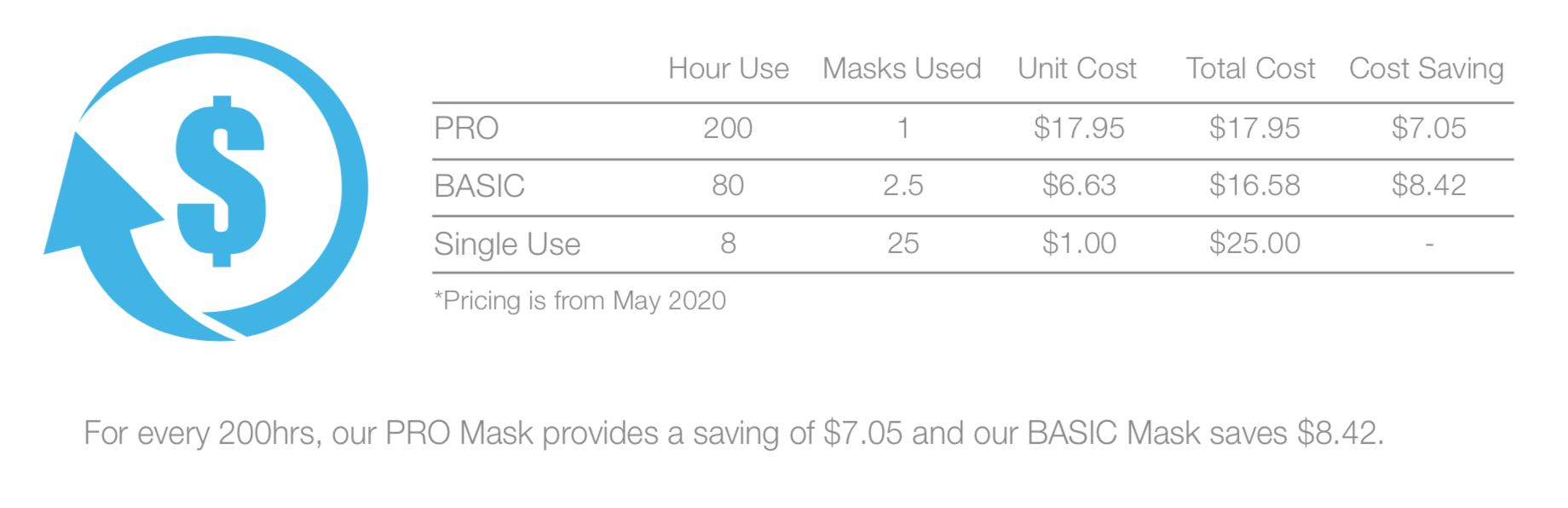
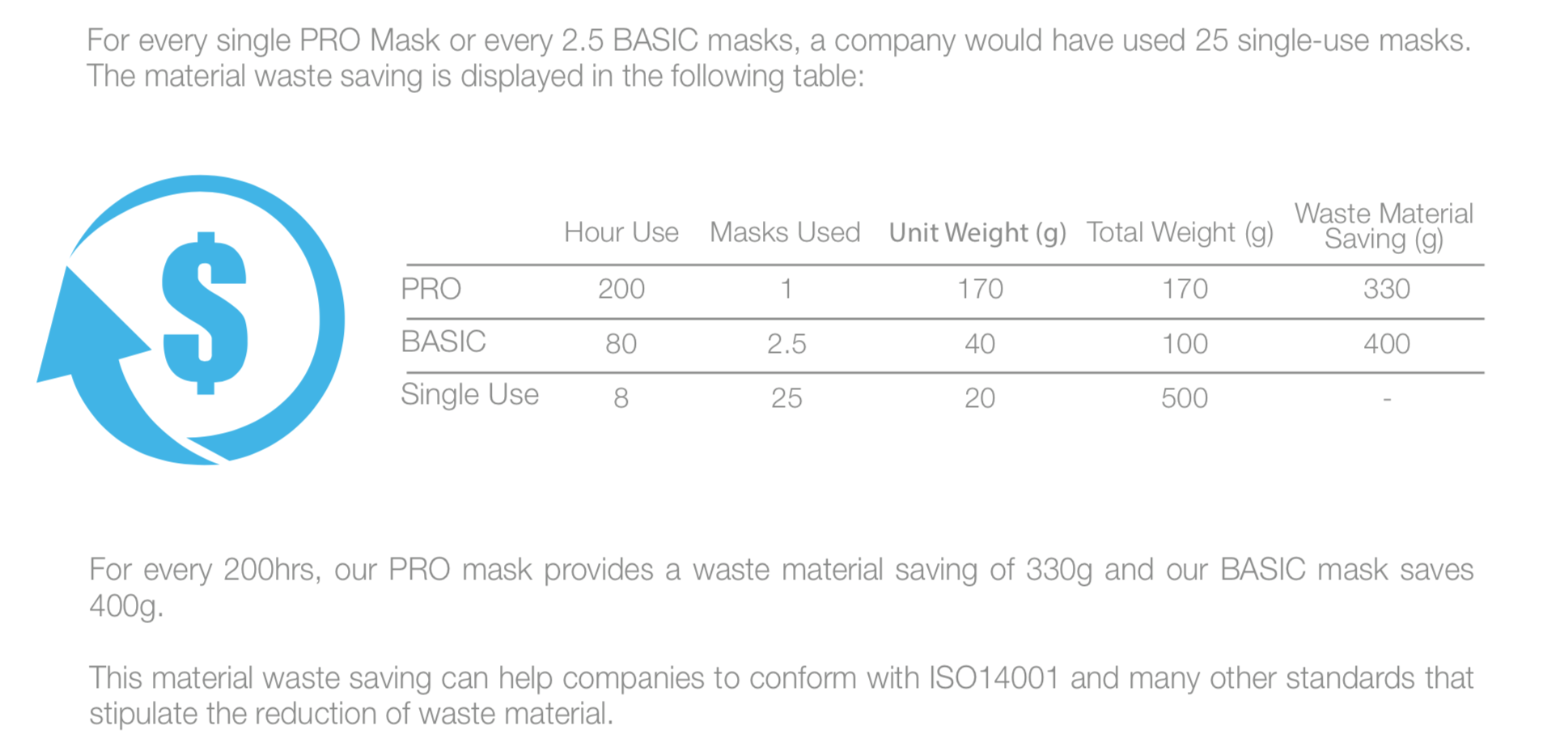
Cambridge Mask Co have helped many of their clients reduce both costs and material wastage by aiding their move away from single-use masks. Their BASIC mask has a lifespan of around 80 hours whilst the PRO lasts for about 200 hours. By calculating the total costs over the same timeframe, one can compare the savings made when using PRO or BASIC masks.
e.g. Company A gives their employees a new mask for each 8hr shift costing $1 per unit.
Cost of Waste
*Cambridge Mask uses exclusive British military technology developed by the Ministry of Defence for chemical nuclear, and biological warfare which ensures the products meet the most stringent international standards. World-leading Nelson Labs, USA, have tested the masks to have a 99.6% viral filtration efficiency and 99.7% bacterial filtration efficiency. The company has experienced rapid growth since its founding and has obtained a reputation for developing market-leading, certified masks with innovative technology that ensures customers’ protection and comfort. The Cambridge PRO provides nearly 100% protection from particulate pollution such as PM10, PM2.5 and PM0.3.